
Workplace
Programs
Workplace Programs
What would happen if your business focused on promoting responsible, engaged fatherhood? How might your “working dad” employees react if they knew their employer was committed to helping them be the best dad they could be? What impact would your workplace see if workers built a real sense of community and could connect with others spanning departments, wages and seniority?
What if we told you all this and more could be achieved over lunch once a week?
Good Dads now offers its Fundamentals for Good Dads course as an employee benefit for leading businesses in the Ozarks that employ fathers and fathers-to-be. We find the course is especially effective in manufacturing settings.
Success Story:
SMC Packaging

We hosted our Fundamentals for Good Dads (formerly Fundamentals of Fatherhood) course as an employee benefit to dads and dads-to-be at SMC Packaging Group in Springfield, MO. The result was an empowering, inspiring experience that men won’t soon forget.
“We are investing in what that employee is going
to become. People matter.”
– Sherrie Stine, HR Manager, SMC Packaging Group
Success Story:
Watson Metal Masters
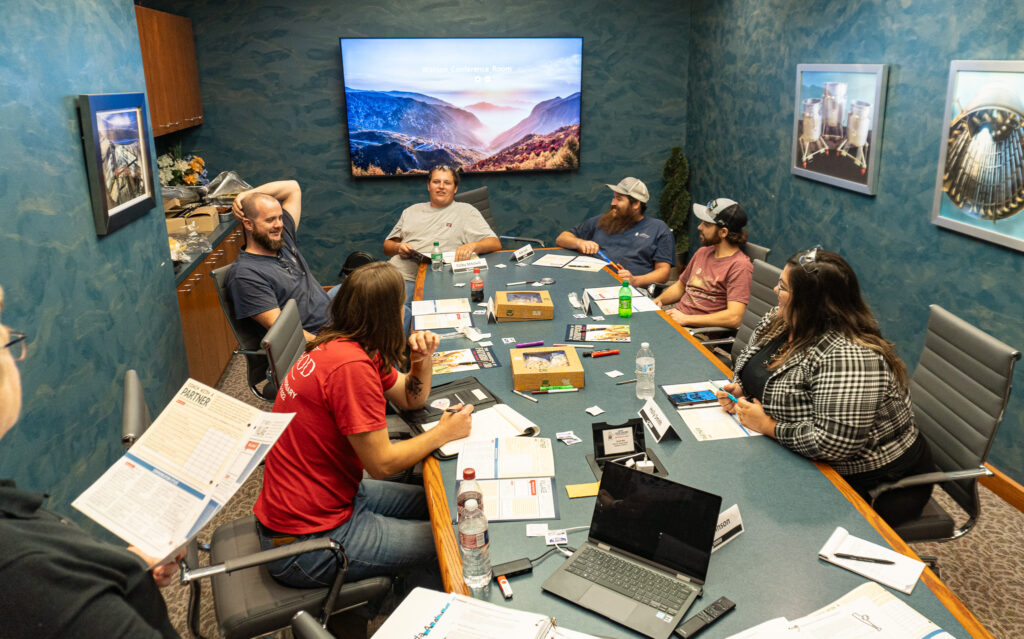
Watson Metal Masters was the latest business in the Ozarks to adopt a lunchtime Fundamentals for Good Dads program for their father employees. This group is reaping benefits from the program both at work and at home as they prioritize being engaged in their children’s lives.
"I'm interested in making sure the team member as a whole is taken care of."
Tiffani Claussen, CEO, WMM

Good Dads Is
Good for Business
Your commitment to fostering a workplace culture that expects ALL dads to be positively involved in the lives of their children starts with Fundamentals for Good Dads, the essential Good Dads playbook.
We envision your workplace as the perfect place for creating a peer-supported group of fathers and soon-to-be fathers. To achieve this vision, you may send members of your own team to a training event hosted by Good Dads so they can learn lead the course, or you can choose to have skilled Good Dads facilitators come to your offices to serve your father employees (local travel only).
Why Focus
on Fathers?
Your commitment to encouraging engaged fatherhood translates to a significant economic impact—for your business and for the community. Here’s some data to back that up.

Happy dads are happy employees.
Men who spend more time with their kids on a typical day are more satisfied with their jobs and are less likely to look for another job, according to a 2015 Academy of Management Perspectives study that surveyed nearly 1,000 fathers working an average 46 hours/week. What’s more, they experience less work-family conflict and greater enrichment in their jobs and at home.

Men in healthy relationships perform at work.
When Dad has a good relationship with Mom, he is generally more involved in his children’s lives, according to research published in the series Fathers, Childcare and Work. Moreover, companies that encourage fathers to be more engaged in their children’s lives have discovered their dad employees are more satisfied and perform better at work.

When Dad is positively involved in his children’s lives, the kids benefit in more ways than one.
Children in state care have higher rates of hazardous behavior. They are more likely to engage in risky sexual behavior and have children of their own during adolescence. They’re more likely to be victims of abuse/neglect and have higher rates of drug/alcohol addiction. When we encourage men to become active parents, we are saving the lives of children who would otherwise be at risk for falling through the cracks.
About Fundamentals for Good Dads
Fundamentals for Good Dads is an 8-part course designed to encourage positive father involvement. The essential Good Dads playbook is the perfect way for any dad (including step-dads, grandfathers and father-figures) to become more engaged with their children. It is the only father-focused program that is also appropriate to use in a co-ed group with mothers.
The course paves the way to forging connections among fathers using familiar language and relatable examples common to any sports lover. It uses an extended coaching metaphor to illustrate that the winning habits successful coaches employ are many of the same strategies that good dads use to raise and lead healthy, happy families.
Participants will explore the following:
- As a dad and as the coach of my family, what can I do to ensure we make it through hard times?
- How can I positively impact my family using my strengths?
- On whom can I rely?
Participants experience a fusion of engaging facilitator-led discussion topics and educational, impactful activities. They use multimedia expert testimonials from professional coaches chiefly relevant to twenty-first century fathers to cover big-picture topics like healthy masculinity, discipline and handling one’s emotions.
Course Objectives
Module 1 Pre-Game Warm-Up
- Understand the goals, format and content of the course.
- Establish rapport with facilitators and other participants.
- Work together to determine and explain acceptable group behavior.
- Explore, identify and discuss the similarities between coaching a team and leading a family.
Module 2 Goals for the Season—Values
- Recognize that a family, like any winning team, needs a game plan with goals to ensure success.
- Explain why rules and standards matter to a team and to families.
- Define “value” and describe the relationship between values and standards.
- Identify personal values and explain why they are important to a safe, stable and happy home.
- Describe the importance of shared couple values and standards to good parenting.
- Understand the influence of family of origin values to one’s adult values.
- Explain how and why values change as one matures.
- Relate how the values of a parent might influence a child’s wellbeing.
Module 3 Becoming a Valued Team Player
- Describe and summarize the impact of childhood role models.
- Evaluate the influence of various parenting role models from childhood on one’s current beliefs about what it means to be a good father or mother.
- Assess the impact of one’s beliefs on current parenting behavior.
- Reflect on the impact of a father’s absence on a child and articulate its effect on the ability to be a good parent.
Module 4 High-Potential Coaches
- Identify strengths of each family member.
- Describe the potential and contributions of each family member.
- Consider and reflect on one’s own strengths and weaknesses regarding parenting.
- Reflect on the ability to control your own attitude and temperament.
- Recognize and explain how each family has its own struggles and strengths.
Module 5 How You Impact Your Players
- Identify and describe the four primary parenting styles.
- Explain how parenting styles are related to a child’s self-management and self-confidence.
- Analyze various parenting scenarios and likely outcomes using various styles of parenting.
- Consider the ways parents may work together to develop the abilities of other family members using their own unique personalities and abilities.
Module 6 Developing Self-Confidence and Resilience
- Define and describe the importance of self-confidence.
- Identify parenting strategies that help encourage the development of confidence in one’s child along with when and why to use them.
- Examine and explain the relationship between accountability and responsibility.
- Identify age-appropriate tasks/chores for children.
- Identify reasonable and age-appropriate consequences for children.
Module 7 Managing Resistance and Conflict
- Explain why conflict is a natural part of life.
- Summarize the value of childish resistance.
- Detail how conflict with one’s children can be managed in positive ways.
- Identify and explain personal anger styles.
- Recognize cues when one is becoming angry.
- Explain and demonstrate ways of resolving conflict.
Module 8 Managing Stress in Your Coaching Network
- Identify and illustrate potential sources of stress in adults and children.
- Brainstorm coping strategies for stress (adults and children).
- Explain the importance of a support network.
- Identify people for one’s support network.
- Identify and demonstrate appropriate ways to ask for help.
- Recognize and construct an appropriate apology.
Bundles & Purchasing Options

Head Coach Bundle
$349.95
- 2 Fundamentals for Good Dads Facilitator Books
- 1 flash drive containing all 8 Coaching Clips
- 20 sets of all 8 Fundamentals for Good Dads Participant Guides

Personal Trainer Bundle
$225.95
- 1 Fundamentals for Good Dads Facilitator Books
- 1 flash drive containing all 8 Coaching Clips
- 10 sets of all 8 Fundamentals for Good Dads Participant Guides
Looking for
other ways
to bundle?
To order additional Participant Guides, flash drives or any other Fundamentals for Good Dads materials, please contact us:
(417) 501-8867
[email protected]
Discover More
"*" indicates required fields