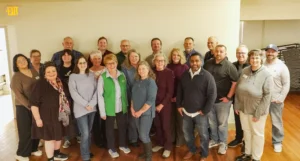

Perhaps you’ve heard the buzz about Fundamentals for Good Dads, the newest curriculum from Good Dads. This eight-part course is an improved and updated version of what was previously called Fundamentals of Fatherhood. Using what we’ve learned as leaders in the responsible fatherhood space, we took all our favorite parts from the original course (which was written in late 2021 and early 2022) and made the rest even better.
Fundamentals for Good Dads was originally focused on helping any dad, including stepdads, grandfathers and father-figures, to be the best dad they can be. Now, a new version of the course also recognizes the role that mothers, wives and partners play in successful co-parenting.
And if you’ll forgive the humble-brag, we’ve got to give ourselves a big pat on the back for being the ONLY father-focused program that is also appropriate to use with mothers.
This means that folks who use Fundamentals for Good Dads may choose to host a class with only men; alternatively, dads may bring along their partners (mothers of his children, wives, girlfriends, step-moms, fiancées, etc.) for a co-ed group.
Dads as Coaches
Fundamentals for Good Dads applies the same habits and philosophies of effective coaches to being a good parent. In Module 1, we explore how great coaches tick — and how the same can be true for becoming a great parent.
We find the metaphor very useful because good dads are leaders. They care about the wellbeing of the family, both as individuals and as a unit. They work hard, and they work collaboratively. They care about relationships. They know their family’s strengths and weaknesses. They have a plan to shepherd their family into a winning season.
Take a peek into each workshop in this new series of workshops for dads and their partners!
Module 1: Pre-Game Warm-Up
Our Why
When you’re asking a dad (and sometimes his partner, too) to attend classes once a week with Good Dads, it can feel intimidating. Even if they take the time to look at our website and familiarize themselves with the Good Dads mission, your participants still won’t totally know what they’ve agreed to.
Is this going to be like group therapy? Am I going to have to talk about my feelings? What if I don’t know anyone else there? These are the sorts of questions that your participants might be asking themselves. Module 1 of Fundamentals for Good Dads is all about dispelling any anxieties about the program.
Instead of leaning on boring, forgettable icebreakers, we were deliberate in our efforts to craft a module that set the tone for the class and made participants feel comfortable and excited about being a part of this new workshop.
Module 1 is all about the basics (the fundamentals, if you will) needed to be a great coach on a winning team. These skills are the same ones that great parents can rely on as their family’s leaders: consistency, planning, values, mindset, etc.
Module 1 Objectives
- Discuss the traits, attitudes and habits a good coach needs. Explore the similarities between good coaches and great parents.
- Describe the kind of home you envision for yourself and your family.
- Establish rapport with your fellow participants and begin to build friendships.
- Work together to determine expectations for group behavior during class.
Our favorite quote: Good “fundamentals” are required for success in any area of life.
When something is fundamental, we consider it to be necessary and essential. Without good fundamentals, it’s difficult, or nearly impossible, to be successful.
We can learn a lot about the fundamentals of great parents by comparing parenthood to coaching a sports team. What are the “fundamentals” of a great coach?
Module 2: Goals for the Season
Our Why
We dedicated an entire module to the topic of goals! Every family has goals—but not everyone has a plan in place to reach them.
Successful teams have goals and standards, but having a goal is not sufficient in itself to achieve a winning season. The best teams know where they are going and what they believe as a team. They know the steps it’ll take to reach the goal. They have strategies in place, and every player knows their role.
The same is true in a family. We all want strong, safe and secure relationships with our loved ones. But some families are much better at connecting this goal with the actual values and activities that will help them achieve their dreams!
Module 2 Objectives
- Recognize that a family, like any winning team, needs a game plan with goals for success.
- Explain why rules and standards matter; identify personal values and shared couple values.
- Explore why values are important to a safe, stable, happy home, especially for child wellbeing.
- Understand how the values in your family of origin may influence your values in adulthood.
Our favorite quote: What standards do you stand for?
If you hold a certain belief or value, it is important to know why you hold that value. Are you just saying it because you heard your parents say it, or do you truly stand by it? You may hold a belief or value someone else finds controversial.
When talking about beliefs and values, it is important we understand that others may not agree with us. But by having a calm, clear discussion, both parties can gain knowledge and understanding of each other.
Module 3: Becoming a Valued Team Player
Our Why
Our culture often presents conflicting ideals regarding healthy masculinity, and that makes knowing what defines a good father even more challenging. In writing this course, we knew it was important to explore what makes a “valuable player” on a team similar to being a Good Dad. Even though it takes everyone working together to forge a winning season, dads may question if they’re even on the team if they are not the star player.
What would it mean for fathers to be equally valuable members of the team? What would it mean for mothers? These are the big questions we explore in Module 3. By the end of the workshop, participants will discover that ANYONE can be a valuable member of their team once they realize who they are and the critical role they play in the family.
Module 3 Objectives
- Define responsible adulthood and explore the cultural transition between adolescence and adulthood.
- Explore possible role models for manhood and fatherhood.
- Reflect on your own childhood and what it was like growing up in your family of origin, analyzing how family of origin influences one’s views of how a man or father should be.
Our favorite quote: Being a good father is especially hard if you didn’t have a good father yourself.
Some days being a team player is harder than others. This is especially true when leadership was not modeled for you in childhood.
Whether you had a good or a bad example, it’s important to know that your view of manhood was influenced by the people around you in your childhood. It’s helpful and important to take time to look back and see what was and was not helpful and healthy.
Many men and women find they have ideas about masculinity that are not helping them, and they have little insight as to how they came to believe and behave as they do.
Module 4: High-Potential Coaches
Our Why
Teams, like families, are made up of all kinds of players, and everyone has their own strengths and weaknesses. You may not have control of the members of your “team,” i.e., their temperament or personality, but you do have control over two things: your own effort and your own attitude.
Module 4 focuses on the stories of dads who face varied challenges: under-employment, divorce, poor anger management, being away from home while traveling for work, etc. Through these scenarios, participants are encouraged to think about the strengths—and barriers—they see in their own families.
Module 4 Objectives
- Compare the traits and characteristics of high-potential coaches to that of high-potential fathers.
- Discuss how judgments or expectations are placed on others.
- Evaluate the challenges dads face in varied fatherhood scenarios, evaluating which candidates have the most potential to be Good Dads.
- Analyze your own parenting potential, considering your strengths and weaknesses.
Our favorite quote: A great coach makes people do what they don’t want to do — so they become who they want to become.
Module 5: How You Impact Your Players
Our Why
Our “why” for Module 5 is simple: Many fathers routinely underestimate their impact on their children! We face a persistent notion in today’s structures that Mom is the “Default Parent.” The idea is that dads are nice to have but are largely unnecessary in child-rearing. This couldn’t be further from the truth!
From the beginning, the Good Dads conviction is that every child benefits from having a loving, present, active father-figure in their lives. The problem is that some dads just don’t know it. In Module 5 we focus on disrupting the notion that dads don’t make that big of a difference to their children’s upbringing and outcomes. The workshop provides plenty of tools for dads who are finding their parenting style.
Module 5 Objectives
- Discuss what makes a coach impactful or influential.
- Consider four primary parenting styles, analyzing the impact of how they were parented growing up.
- Using familiar parenting scenarios, practice responding in various ways to child misbehavior with an emphasis on becoming an Authoritative Parent.
Our favorite quote: Children of authoritative parents tend to be self-reliant, socially competent with good emotional regulation.
Authoritative parents express a high level of emotional support while setting loving limits and healthy boundaries.
They allow their children to make some of their own age-appropriate decisions and learn from their mistakes. Authoritative parents communicate a reliable message of encouragement and support while letting the consequences of a child’s actions do the teaching as often as possible.
Module 6: Developing Self-Confidence & Resilience
Our Why
A big part of a coach’s job is to maintain positive morale among players. In fact, many players turn to their coach to help them develop the skills and confidence they need to play their best game on the field or court. Children, for their part, rely on parents for many of the same needs. Kids learn their value and worth based on interactions with Dad and Mom.
So how do you develop a great player? How do you encourage your sons and daughters at every stage of their development? In Module 6 we turn our attention to understanding what families need to be confident and resilient. This includes responsibilities, accountability, relationships, routines, dialogue, encouragement and so much more.
Module 6 Objectives
- Explore the importance of confidence to maintaining a positive morale.
- Discuss the kinds of actions and behaviors that help parents and children be more confident.
- Consider how one’s confidence improves when given opportunities to persist, struggle and overcome challenges with support from others.
- Practice Relational Accountability statements and other tools to manage child responsibility/chores.
Our favorite quote: Building self-confidence includes learning to work hard and struggle.
While feeling loved is important, it is insufficient in and of itself to build self-confidence. It also requires the ability to take risks, be willing to struggle, and to persist in the face of challenges or difficulties.
If you want to develop self-confidence in your children, they also need opportunities to work hard and struggle. Great coaches routinely reinforce accountability and responsibility with encouraging words and practice.
Module 7: Managing Resistance & Conflict
Our Why
The emergence of self-will and resistance is a normal part of child development, but it often sends parents into high alert. What do you do when your four-year-old has a full-blown tantrum at the grocery store check-out or your preteen is putting off doing chores? Of course, not all conflicts are bad. We can learn a lot from how coaches handle conflict among their players and apply it to the ways dads can lead their families.
Because conflict is a natural and unavoidable part of life, we use Module 7 as a place to learn about managing emotions, taking time-outs, correction, consequences, empathy and more!
Module 7 Objectives
- Discuss the value of conflict and resistance in everyday life.
- Practice recognizing childhood resistance as an avenue for learning; practice managing yourself as a parent before trying to manage children.
- Identify important de-escalation actions in highly emotional scenarios.
- Explore the roles of empathy, safety, understanding and perspective in conflict resolution.
Our favorite quote: Learn to recognize when you are “heating up,” i.e., experiencing low-level anger.
It’s not always easy to recognize low-level anger because it’s often cloaked in other terms, like bugged, irritated, annoyed, or bothered.
The first step to managing your own anger is recognizing when you’re feeling angry. Coaches need to express anger wisely during a game because there are steep consequences for blowups. It’s crucial to keep it from progressing to higher levels.
Module 8: Managing Stress in Your Coaching Network
Our Why
Like conflict, stress is a natural part of life. But it matters what we choose to do with our stress. In Module 8, we zoom out beyond just the immediate family to explore what it means for dads (and coaches) to rely on the support of others.
The most successful teams have a small army of supportive people, like sports psychologists, athletic trainers and assistants. Even the best coach in the world would never dream of doing everything himself. Likewise, dads shouldn’t expect to handle everything solo.
Module 8 Objectives
- Reflect on the importance of collaboration to coaches and parents.
- Evaluate ways stress impacts relationships and children.
- Examine the importance of relying on a network of supportive relationships in a strong family.
- Identify a variety of practical ways of asking for help.
- Consider the elements of a good apology to one’s child.
Our favorite quote: It takes a village to raise a child.
This African proverb means an entire community of people must provide for and interact positively with children for those children to experience and grow in a safe and healthy environment.
Identifying your coaching support network—that is, the people in your village—is crucial for your own wellbeing and the wellbeing of your kids.
Hop on the Good Dads Bandwagon!
One of the best parts of Fundamentals for Good Dads is its versatility. You’ll find a perfect fit in a number of settings and uses depending on your unique needs and goals.
- In the workplace: Meet your employees over lunch as an HR benefit.
- At a couples’ retreat: Use course materials to guide co-parents through important parenting scenarios.
- In your place of worship: Supplement each module with teachings from scripture in a faith-based setting. Find purchasing options and course samples on the Good Dads website.
Find purchasing options and course samples on the Good Dads website.